Tomb of Christopher Columbus
About
What It Is
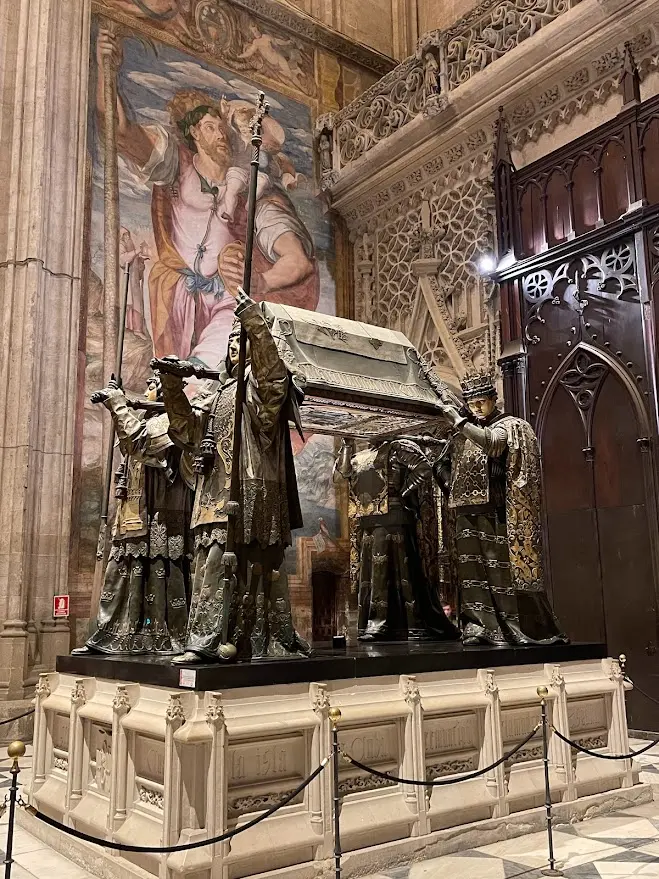
The Tomb of Christopher Columbus is a funerary monument housed in the south transept of Seville Cathedral, where it has stood since 1899 [1][2]. The monument contains the remains of Columbus, who died in Valladolid on May 20, 1506, and whose body traveled through multiple locations — including the Monastery of Santa Maria de las Cuevas in Seville, the Cathedral of Santo Domingo, and Havana — before arriving at its current site [1]. In October 2024, researchers from the University of Granada led by forensic scientist Jose Antonio Lorente confirmed through DNA analysis that the bones in the cathedral do belong to Columbus, comparing them with remains of his son Fernando and his brother Diego [1].
Activities & Experiences
Visitors can view the monument in person within the south transept of Seville Cathedral [2]. The sculpture itself rewards close inspection: Columbus's coat of arms is incised into the casket, and the four larger-than-life pallbearer figures carry symbolic emblems tied to the Spanish Crown and the era of conquest [2]. A model of the original design by sculptor Arturo Melida, which includes details now lost to damage, is held separately at the Prado in Madrid [2].
Practical Access
The tomb is located inside Seville Cathedral at coordinates 37.3859, -5.9926, in the Andalusia region of Spain [1][2]. Access to the monument is through the cathedral itself; no source details specific hours, fees, or reservation requirements for this attraction independently of the broader cathedral visit.
Restrictions
No specific restrictions noted in the sources.
What Makes It Distinctive
The monument was designed by Arturo Melida following a royal-decree competition initiated in 1891, originally intended for the Havana Cathedral to mark the 400th anniversary of Columbus's voyage to the Americas [2]. When Spain lost Cuba in 1898, the monument was transferred to Seville, giving it a layered historical significance that extends well beyond the burial itself [2]. The four pallbearer figures represent the kingdoms of Spain and carry iconography — including the emblem of Mary and the image of Saint James the Matamoros — that encodes the ideology of Spanish colonialism, making the monument as much a statement about imperial power as a memorial to Columbus [2]. The 2024 DNA confirmation, after decades of competing claims about the true location of Columbus's remains, adds a further dimension of scientific and historical resolution to the site [1].
Sources
- Open year-round
- Typical duration: 1h
Things to do
- examine casket coat of arms
- tomb within cathedral interior
- view monument in person
Before you go
- ongoing scholarly research
- some original monument details lost
- whether all bones present unresolved
Events & seasons
- dna study announced
Features
- columbus coat of arms
- columbus died valladolid
- columbus remains confirmed
- designed by arturo melida
- dna compared with fernando and diego
- DNA compared with son and brother
- dna identity confirmed
- dna study led by jose antonio lorente
- Dominican Republic rival claim
- earlier DNA study 2003–2005
- four pallbearer figures
- funerary monument
- multiple prior burial sites
- one of largest Gothic cathedrals
- original design model
- remains crossed Atlantic multiple times
- remains in santo domingo until 1795
- remains traveled multiple locations
- symbolic iconography on staffs
- tomb since 1899
Good to know
- inside seville cathedral
- no fees or reservations stated