Stuðlagil Canyon
About
What It Is
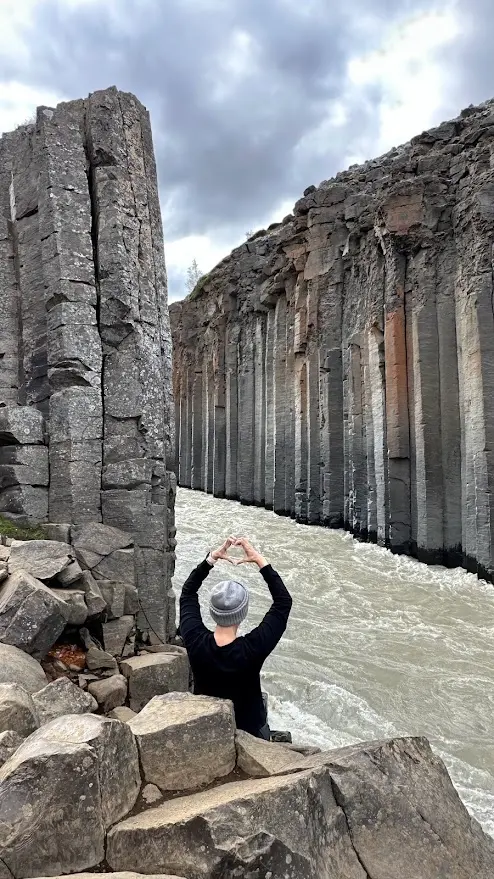
Studlagil Canyon is a basalt column canyon situated in the Jokuldalur valley in East Iceland, accessible via Road 923 near Route 1 [1]. The canyon is defined by tall hexagonal basalt columns formed through the slow cooling and contraction of ancient lava flows, a geological process known as columnar jointing [1]. A glacial river runs through the canyon, carrying fine suspended silt that gives the water a vivid turquoise color, most pronounced during summer months [1].
The canyon's existence as a visible landmark is a direct consequence of the Karahnjukar Hydropower Plant, completed in 2009, which diverted water from the Jokulsá a Dal river and reduced its flow from roughly 205 cubic meters per second to around 95 cubic meters per second [1]. This reduction exposed basalt formations that had previously been submerged and transformed the river from a sediment-heavy brown to its current turquoise appearance [1].
Activities & Experiences
Visitors can view the canyon from a platform on the west bank, which offers a direct sightline to the basalt columns and river below [1]. Those seeking a closer experience can hike the east bank trail, a 5 km route that brings visitors nearer to the formations [1]. The primary draw is observing the combination of vertical basalt columns rising from the riverbed and the turquoise glacial water running between them [1].
Practical Access
The canyon is reached via Road 923, branching off Route 1 [1]. Parking areas and footpaths have been developed since 2019 to accommodate increased visitor numbers [1]. The recommended visiting window is June through October, when trail conditions are more reliable and the river's turquoise coloration is at its most vivid [1]. Winter visits carry elevated risk due to icy roads and paths [1].
Restrictions
No specific restrictions noted in the sources.
What Makes It Distinctive
Studlagil is notable among Icelandic basalt column sites for the height, quantity, and alignment of its formations, which rise vertically from the riverbed in dense, organized rows [1]. The canyon's turquoise river, a direct result of hydropower diversion rather than natural hydrology, creates a color contrast with the dark basalt that is unusual even by Icelandic standards [1]. The site is also a documented case of accidental conservation, where large-scale industrial intervention inadvertently created a significant natural attraction in a remote region [1]. Its discovery was formally recognized by Iceland's Minister of Tourism in 2018, and a 2019 academic report by the University of Iceland and the Icelandic Tourism Research Centre validated its documentation [1].
Sources
- Best months: June–August