Sedona
About
What It Is
Sedona is a city in northern Arizona, straddling the county line between Coconino and Yavapai counties, situated within the Coconino National Forest [2]. It sits approximately 120 miles north of Phoenix and 30 miles south of Flagstaff, in the Verde Valley region [3]. The city had a population of 9,684 as of the 2020 census [2]. Its defining characteristic is an extensive landscape of pink sandstone formations, shaped by the Schnebly Hill Formation, a thick layer of Permian-period sandstone found only in this vicinity [2]. The city describes itself as committed to preserving its natural beauty, scenic vistas, and cultural heritage [1].
Activities & Experiences
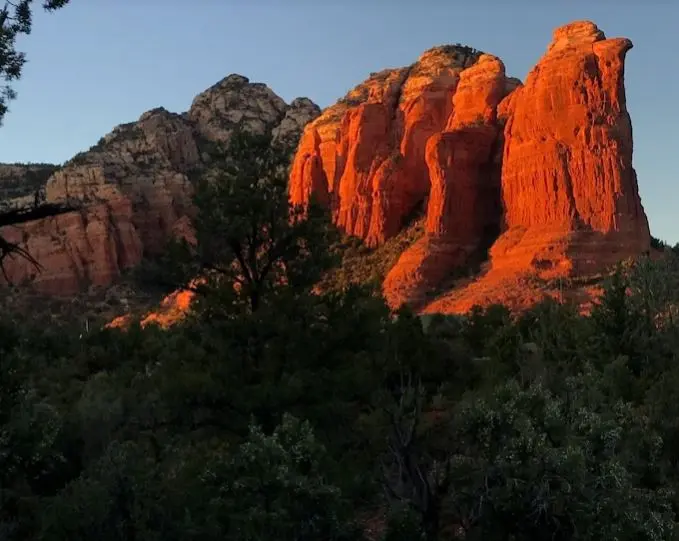
The red rock landscape is the primary draw, visible from virtually anywhere in the city and serving as the backdrop for hundreds of hiking and mountain-biking trails [2][3]. Visitors can explore notable rock formations including Bell Rock, Cathedral Rock, Capitol Butte, Courthouse Butte, and Wilson Mountain, the highest point in the area [2]. Boynton Canyon is among the most scenic box canyons and offers a popular trail, while the Broken Arrow Trail provides an easy 2-mile hike to Chicken Point [3]. Jeep tours, trolley tours, and guided outdoor adventures including rock climbing, canyoneering, and astronomy tours are also available [3].
Sedona supports a vibrant arts community with nearly 100 art galleries and recurring events including the Sedona International Film Festival, the Sedona Arts Festival, and the Sedona Jazz Festival [3]. Two Sinagua archaeological heritage sites, Palatki and Honanki, offer cliff dwellings, pictographs, and petroglyphs dating from roughly 1100 to 1400 CE [3]. The Chapel of the Holy Cross, completed in 1956, rises out of a redrock cliff and is open to visitors [2][3]. The Sedona Heritage Museum covers the history of early settlement in the area [3].
Practical Access
Sedona is reached primarily by car via Arizona State Route 89A or AZ 179; AZ 179 is designated an All-American Road and passes through red rock terrain [3]. Sedona Airport (SDX) is too small for scheduled jet service and serves private aviation only; the nearest major airports are Phoenix Sky Harbor and Phoenix Mesa Airport [3]. Limited public transit exists within the city, and a vehicle is realistically required to reach trailheads and most destinations [3]. Walking is possible in some areas but insufficient for full access [3].
A Red Rock Pass is required to park at trailheads, priced at 5 USD per day, 15 USD per week, or 20 USD per year; passes are sold at multiple locations including the Sedona Chamber of Commerce Visitor Center and online [3]. The Visitor Center also has a National Forest Service ranger available to answer questions about regional hikes [3]. Palatki Heritage Site is open daily 9:30 AM to 3:00 PM and reservations are recommended due to managed visitor numbers; Honanki Heritage Site is open daily 9:30 AM to 4:00 PM and does not require reservations [3]. The Sedona Heritage Museum is open daily 11:00 AM to 3:00 PM and charges 5 USD for adults and is free for children under 13 [3].
Restrictions
A Red Rock Pass must be displayed on all vehicles parked at trailheads; passes are not sold at Honanki Heritage Site and must be purchased in advance [3]. Visitor numbers at Palatki Heritage Site are actively managed by rangers to limit damage to the site [3]. Parking at the Boynton Canyon trailhead does not permit parking at the adjacent luxury resort [3].
What Makes It Distinctive
Sedona's pink sandstone geology is geologically unique: the Schnebly Hill Formation occurs only in this vicinity and produces the vivid coloration that intensifies at sunrise and sunset [2]. The city has a documented cinematic history spanning more than sixty Hollywood productions from 1923 through the 1970s, lending it a cultural layer uncommon among natural destinations [2]. The combination of accessible archaeological sites, a concentrated arts scene with nearly 100 galleries, recurring cultural festivals, and an extensive trail network for multiple activity types makes Sedona unusually broad in its visitor appeal compared to single-purpose natural attractions [3].
Sources
- Best months: March–May