Reynisfjara Beach
About
What It Is
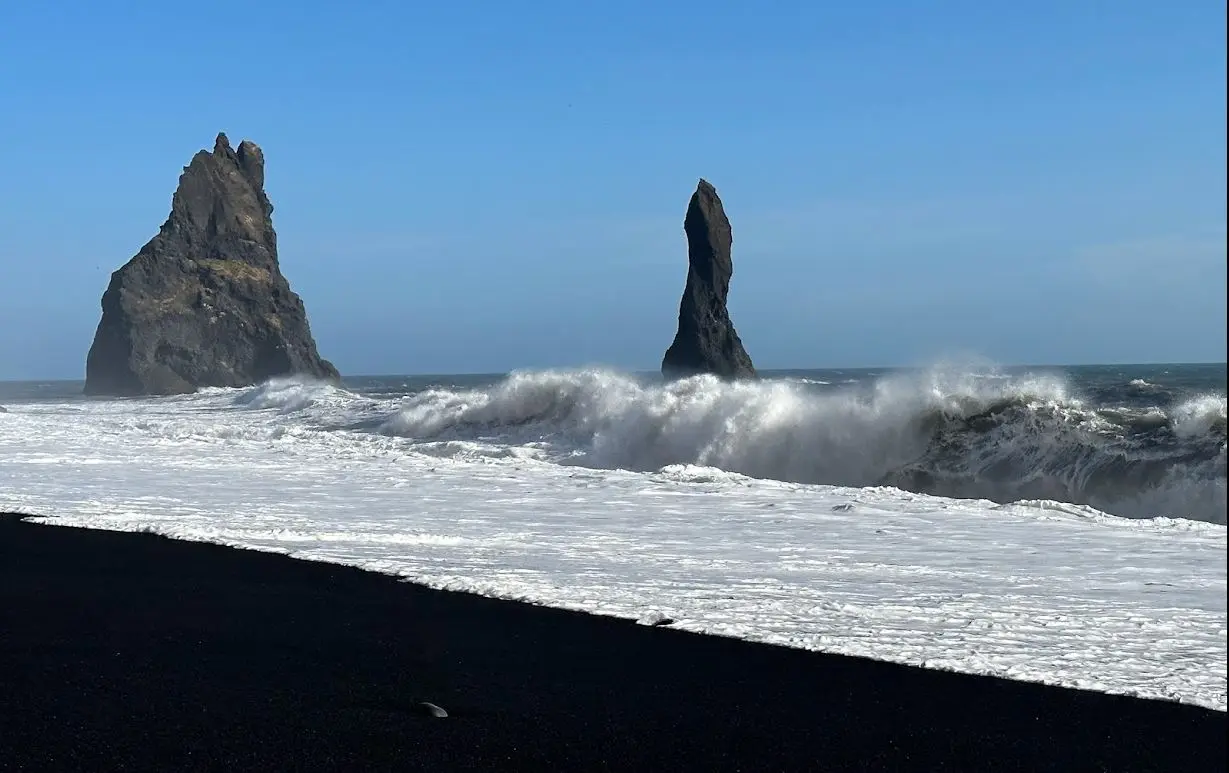
Reynisfjara is a black sand beach on Iceland's South Coast, situated near the village of Vik i Myrdal and accessible from the Ring Road (Route 1) [2]. The beach stretches approximately 3 kilometers (1.9 miles) and sits at the base of Reynisfjall, a 340-meter tuff mountain formed by a volcanic eruption beneath a glacier during the penultimate Ice Age [2][3]. It is part of the Katla UNESCO Global Geopark and sits on privately owned land [1]. The beach draws visitors year-round for its volcanic geology, dramatic coastal formations, and position within a broader landscape that includes the Eyjafjallajokull volcano, visible from the shore [1].
Activities & Experiences
Visitors can walk the long black sand shoreline, observe the Reynisdrangar sea stacks rising 66 meters out of the sea just offshore, and explore the Halsanefshellir Cave at the eastern end of the beach, which is framed by hexagonal basalt columns [2][3]. The Gardar Cliff at the back of the beach offers a vantage point for photography of the basalt formations [2]. Birdwatchers can look for Atlantic puffins and other seabirds nesting on the cliffs from May to August [2][5]. In winter, the beach offers a chance to see the Northern Lights above the sea stacks [2]. The beach has also served as a filming location for productions including Game of Thrones [2][5].
Practical Access
Reynisfjara is approximately 180 km (112 miles) from Reykjavik, roughly a 2.5-hour drive along the Ring Road; the drive from Vik takes about 12 minutes [5]. The beach is reachable by private car or guided tour bus, and two paid parking lots are available on site [2][5]. Parking costs 1,000 ISK (approximately USD 7) and is paid via the Parka app [5]. There is no entrance fee to the beach itself [2]. Visitors should allow approximately one hour for a visit [5]. The beach is open year-round, though winter driving on Route 1 can be more challenging due to snowfall [5].
Restrictions
A three-level wave warning system governs access: yellow indicates moderate hazard and requires general alertness; orange indicates considerable hazard and requires staying at least 25 meters (82 feet) from the water; red indicates severe hazard and closes the beach, with visitors permitted only at a designated viewing area [4]. Following a fatal incident in August 2025, the Halsanefshellir Cave and basalt columns are subject to closure during red warning conditions [1]. Children must be accompanied by an adult at all times, and visitors are warned to stay well back from the water's edge, never turn their backs on the sea, and remain alert to falling rocks near the cliff [4]. Conditions can change rapidly and local safety officers may close the beach with short notice [4].
What Makes It Distinctive
Reynisfjara was nominated as one of the world's most iconic beaches and shorelines by National Geographic in 2025 [5]. Its black sand is composed of volcanic ash and minerals produced by the erosion of hardened lava, a formation process that makes black sand beaches significantly rarer than white or golden sand beaches [5]. The combination of the offshore Reynisdrangar sea stacks, the hexagonal basalt columns of the Gardar Cliff, the Halsanefshellir Cave, and the visible Eyjafjallajokull volcano in the background creates a concentration of dramatic volcanic features found together at very few beaches in the world [1][2][3]. In February 2026, winter storms caused partial collapse of the basalt columns and significant beach erosion, with conditions expected to recover following the return of westerly winds in March 2026 [1].
Sources
- Best months: June–August