Park Güell
About
What It Is
Park Güell is a complex of parks, gardens, and architectural structures designed by Antoni Gaudí, located in the La Salut neighborhood of the Gràcia district in Barcelona, Catalonia, Spain. [2] It sits on the southern slope of the Turó del Carmel hill, part of the Collserola mountain range, and looks out over the city. [2] Catalan industrialist Eusebi Güell commissioned Gaudí to design the site during Barcelona's late 19th and early 20th-century urban expansion; construction ran from 1900 to 1914, and the park opened to the public in 1926. [2] UNESCO designated it a World Heritage Site in 1984 as part of the Works of Antoni Gaudí collection, recognizing how its architecture combined Arts and Crafts, Symbolism, Expressionism, and Rationalism while anticipating many techniques of 20th-century Modernism. [2]
Originally conceived as a high-end private residential development for the bourgeoisie — inspired by the English garden city movement — the project attracted few buyers, as the location was considered too remote from the city centre. [2] Only two homes were ever built, and the site eventually became a municipal garden. [2]
Activities & Experiences
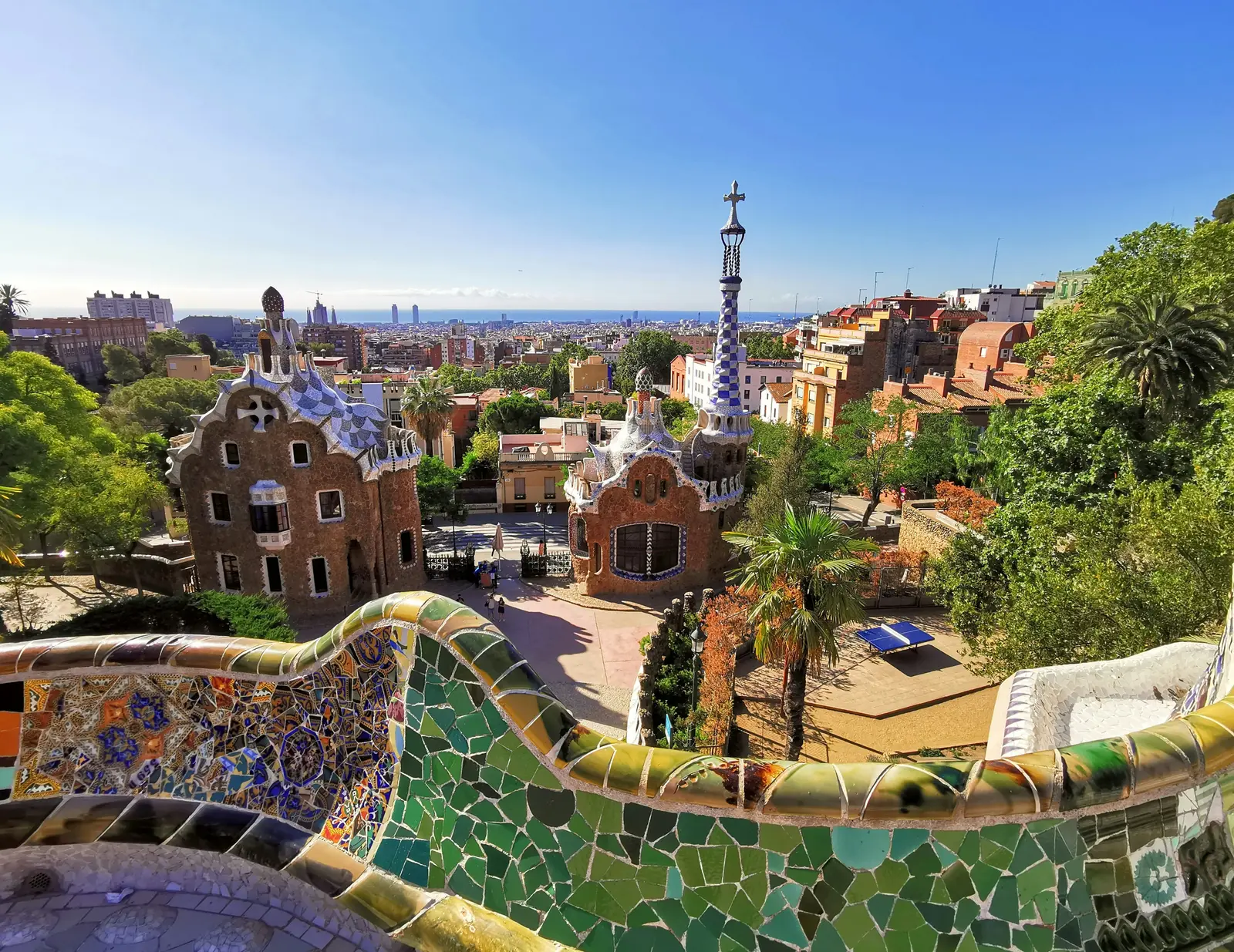
Visitors can explore the Monumental Zone, which includes the main terrace, decorative mosaics, viaducts, and the gate area. [2] The focal point of the terrace is a long, curving bench shaped like a sea serpent, designed by Josep Maria Jujol, whose ergonomic form creates enclaves intended to encourage social interaction. [2] The bench and the vaulted hall beneath the terrace — its columns decorated with mosaics recalling Roman grotesque motifs, particularly those of the Domus Aurea — are among the park's most visited features. [2]
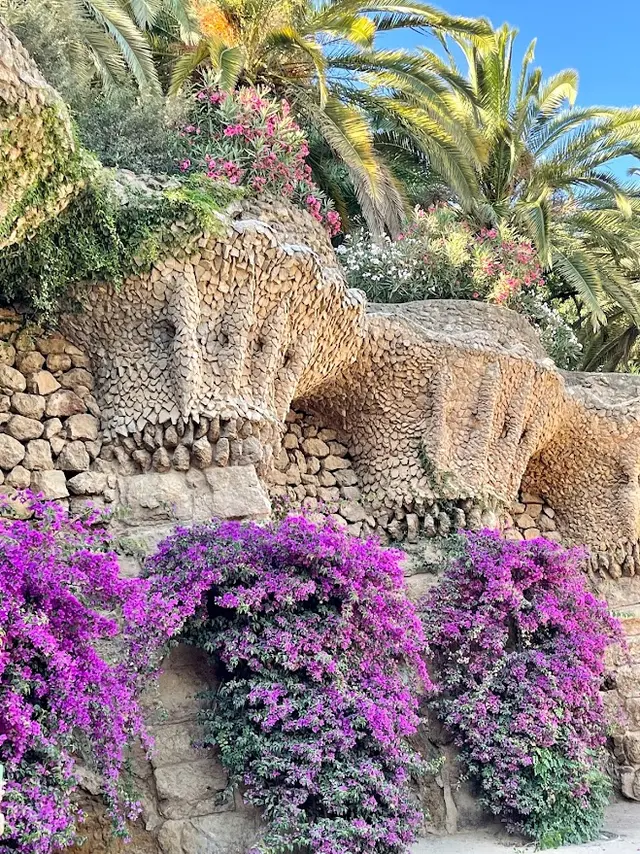
A network of elevated pathways, originally designed for carriages and built from local stone, winds through the park; their columns and vaulted supports mimic tree trunks and natural forms. [2] At the park's highest point, steps lead to El Turó de les Tres Creus, a calvary of three stone crosses, from which visitors can see the Sagrada Família, Torre Glòries, Montjuïc, and the Mediterranean. [2] The park also supports diverse wildlife, including non-native parrots, hummingbird hawk moths, and occasional sightings of the short-toed eagle. [2]
Guided visits are available in Catalan, Spanish, and English through official park guides; Catalan-language guided tours carry a 50% discount on the guiding fee. [1] The Casa del Guarda, situated beside the monumental staircase, is open as an interpretive space covering the park's history and heritage, accessible with a combined ticket. [1] The Casa Museu Gaudí — the house where Gaudí lived from 1906 to 1925, designed by Francesc Berenguer i Mestres — has reopened after restoration and can be visited separately; a discount is available for visitors who also visit the Sagrada Família. [1][2]
Practical Access
The park is reachable by Barcelona Metro, with Vallcarca and Lesseps being the closest stations, though neither is immediately adjacent to the entrance. [2] Buses and tour buses also serve the site. [2] Entry to the Monumental Zone requires a ticket (since October 2013); Barcelona residents enter for free. [2] Tickets frequently sell out, so advance booking is recommended. [2] Official tickets and guided tour reservations can be made through the park's official website. [1]
The park may close temporarily due to adverse weather conditions for safety reasons. [1] Ongoing works to improve the drainage, sanitation, and irrigation systems are in progress and may affect the visitor experience. [1]
Restrictions
Entry to the Monumental Zone requires a paid ticket; free entry applies to Barcelona residents. [2] The Monumental Zone and the Casa del Guarda require separate or combined tickets; the Casa Museu Gaudí entry is also separate. [1][2] No additional restrictions are stated in the sources beyond ticketing requirements and the possibility of closure during severe weather. [1]
What Makes It Distinctive
Park Güell is one of the few UNESCO World Heritage Sites that functions simultaneously as a working urban park, a neighborhood green space, and a major architectural monument. [2] It represents Gaudí's naturalist period, during which his study of organic forms and geometric analysis produced structural and decorative solutions that directly influenced 20th-century Modernism. [2] The combination of large-scale mosaic work, stone viaducts that blend into the hillside landscape, panoramic views over Barcelona, and the layered symbolic program — referencing Catalan political identity, Catholicism, and classical mythology — gives the site a density of meaning unusual among public parks. [2] It holds the Biosphere certification for responsible and sustainable tourism, awarded with UNESCO support, reflecting ongoing efforts to balance visitor access with ecological and community values. [1]
Sources
- Open year-round
Things to do
- guided tours
- panoramic viewpoint
- visit casa museu gaudí
Amenities
- barcelona city history museum exhibit
Events & seasons
- children's christmas decoration activity
- open-air concerts, plaça de la natura
Features
- el turó de les tres creus
- hypostyle hall columns
- monumental salamander sculpture
- serpentine mosaic bench
- unesco world heritage site
- viaducts of local stone
Nearby
- parc del carmel
- sagrada família
Good to know
- biosphere certified
- bus access available
- metro access
Photos