Loch Ard Gorge
About
What It Is
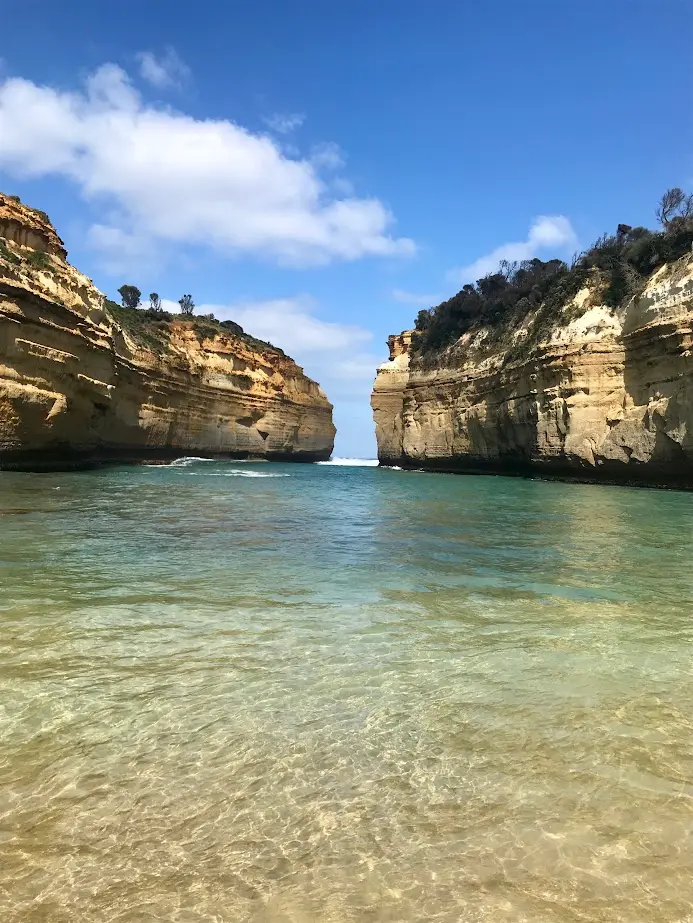
Loch Ard Gorge is a coastal gorge within Port Campbell National Park, located on the Great Ocean Road's Shipwreck Coast in Victoria, Australia, approximately 3.5 kilometres northwest of the Twelve Apostles [2]. The site takes its name from the clipper ship Loch Ard, which wrecked on 1 June 1878 during a voyage from England to Melbourne, killing 52 of the 54 people on board [2]. The two survivors, apprentice Thomas Pearce and passenger Eva Carmichael, were both 19 years old; Pearce rescued Carmichael from the water and climbed out of the gorge to summon help from local pastoralists [2]. The gorge is recognised as a heritage site, with on-site memorials, a small museum, and a cemetery where several of the Loch Ard's passengers are buried [2].
Activities & Experiences
Visitors can walk to the eastern side of the gorge along a dedicated pathway and view the dramatic rock formations from above and at the gorge level [2]. The site contains numerous plaques and a small museum covering the history of the shipwreck and its survivors, as well as a rest area [2]. The nearby rock pillars, officially named Tom and Eva after the two survivors, are a notable feature following the collapse of the Island Archway in June 2009 [2]. The rufous bristlebird, an uncommon species, is frequently observed around the gorge [2].
Practical Access
The gorge is reached via the Great Ocean Road and sits about a three-minute drive west of the Twelve Apostles [2]. Stairs that previously provided direct beach access are temporarily closed due to geological instability and will remain closed until remediation works are completed; a pathway to the eastern side of the gorge remains open [2]. No fees, hours, or typical visit duration are stated in the available sources.
Restrictions
Beach access via the stairs is temporarily closed due to geological instability, with no confirmed reopening date [2]. No additional restrictions are noted in the sources.
What Makes It Distinctive
Loch Ard Gorge combines dramatic coastal geology with a specific and well-documented maritime tragedy, giving it a historical depth that purely scenic stops along the Great Ocean Road lack [2]. The on-site cemetery, museum, and named rock formations all connect directly to the 1878 wreck and its two survivors, making the heritage narrative unusually tangible and localised [2]. The site has also served as a filming location for several productions, including The Amazing Race Australia and the 1982 film The Pirate Movie [2].
Sources
- Open year-round
Access & fees
- not stated
Things to do
- coastal/clifftop viewpoints
- geological exploration
- gorge beach access
- longer coastal walking through the precinct
- scenic walking & short trails
- seasonal whale spotting in the wider port campbell coast
- sunset/scenic viewing
- wildlife observation
Amenities
- rest area on site
- there are three principal walks: the geology walk (1 km return / ~40 min), shipwreck walk (1.4 km / ~50 min) and living on the edge walk (3.2 km / ~1.5 hr).
Features
- on-site cemetery
- see short-tailed shearwaters returning to mutton bird island around dusk, generally october–april
- shipwreck heritage site
- small shipwreck museum
- tom and eva rock pillars
Nearby
- twelve apostles
Good to know
- access via great ocean road
- beach stairs closed
- wheelchair accessible: partial — accessible parking and selected clifftop viewpoints; beach inaccessible.