Lake Mývatn
About
What It Is
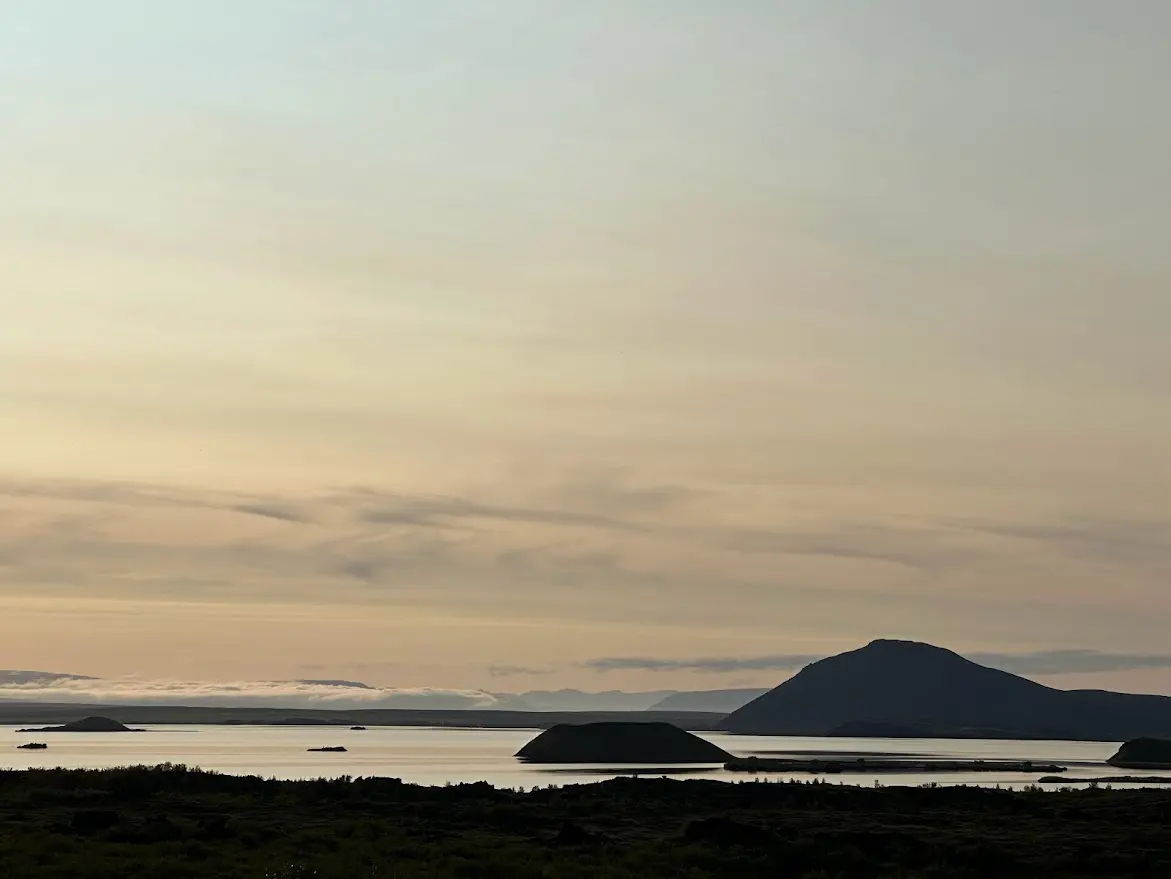
Lake Mývatn is a shallow, volcanogenic lake in northern Iceland, situated near the Krafla volcano in an area of active volcanism [2]. It covers approximately 37 square kilometers and ranks as the fourth largest lake in Iceland, with an average depth of just 2.5 meters and a maximum depth of 4.5 meters [2][3]. The lake was formed roughly 2,300 years ago when a large basaltic lava eruption spread across the region; when the lava contacted wetlands, steam explosions created pseudocraters and the blocked drainage eventually impounded the water [1][2]. The lake, the outflowing river Laxá, and the surrounding wetlands together form the Mývatn–Laxá Nature Conservation Area, a legally protected reserve of 4,400 square kilometers that is also listed as an internationally important Ramsar wetland [2][3].
The name Mývatn translates from Icelandic as "lake of midges," a reference to the dense swarms of chironomid flies that gather around the water in summer [1][2]. These midges are not merely a nuisance; they are a foundational part of the lake's food web, supporting the exceptional diversity of waterbirds that breed and feed here [1].
Activities & Experiences
Birdwatching is one of the primary draws, as Mývatn hosts more duck species simultaneously than any other location in the world during summer [3]. Visitors may observe whooper swans, Arctic terns, red-necked phalaropes, great northern divers, tufted ducks, greater scaup, Barrow's goldeneye, and several other species; late May and June are considered the peak weeks for duck observation [1]. The lake's roughly 50 small islets and the indented shoreline with its many coves and inlets provide varied vantage points for wildlife observation [3].
The broader Mývatn area contains a cluster of geological attractions that visitors typically combine into a single itinerary [1]. These include the Dimmuborgir lava formations, Hverfell crater, the Námaskarð geothermal area, the Grjótagjá hot spring cave, Viti crater at Krafla, Lofthellir ice cave, and the Skutustaðagigar pseudocraters [1]. In winter, dog sledding tours operate near the lake, run by local operators from the Vallholt farm between Akureyri and Mývatn, with approximately one hour on the sled and a kennel visit included in a roughly two-hour outing [5][6]. An annual marathon circumnavigating the lake on a flat asphalt road takes place on the last weekend of May, with 10 km, 21 km, and 42 km distances available [4].
Practical Access
Mývatn is located approximately 6 to 7 hours by car from Reykjavik and about 1.5 hours from Akureyri [1]. The lake sits along Road 1 (the Ring Road), with a postal code of 660 [3]. Domestic flights and guided tours from Akureyri also provide access [1]. The area features a tundra climate with cool summers and long, cold winters; summer brings the midnight sun and peak birdwatching conditions, while winter offers northern lights and snow-based activities [1][2]. Accommodation options in the area include hotels and farm stays, and dining is available locally [1].
For the annual Mývatn Marathon (as of May 2026), registration closes online the day before the event, with same-day registration available at the Mývatn Nature Baths; entry fees range from ISK 8,900 to ISK 16,900 depending on distance and registration timing [4]. Dog sledding tours with Geo Travel operate from November to May depending on snow conditions, last approximately 2 to 2.5 hours, and are priced at ISK 40,000 per person with a minimum of two adults; transfers are charged separately [6].
Restrictions
The lake and surrounding wetlands are a legally protected nature conservation area [2][3]. Swimming in Grjótagjá hot spring cave is no longer permitted due to geological activity that raised water temperatures in the period 1975–1984 [3]. Dog sledding tours are not considered suitable for pregnant women, and participants exceeding 100 kg are asked to notify the operator in advance [5]. Tours operate on snow or ice only and may be relocated or cancelled if snow conditions are inadequate, with a full refund provided in the event of cancellation [5][6].
What Makes It Distinctive
Mývatn's combination of active volcanism and exceptional biological productivity in a single compact area is rare globally [1][2]. The lake simultaneously offers pseudocraters, lava formations, geothermal pools, and an ice cave within a short distance of one another, making it one of the most geologically varied lake environments accessible to general visitors [1]. Its status as the world's most duck-species-rich lake during summer, alongside the recovering marimo algae colonies found in only a handful of locations worldwide, gives it ecological significance that extends well beyond Iceland [1][3]. As a key stop on the Diamond Circle touring route, it also connects naturally to other major North Iceland landmarks including Dettifoss, Ásbyrgi Canyon, Goðafoss, and Húsavík [1].
Sources
- Best months: June–August
Access & fees
- lake access free
Things to do
- birdwatching
- cave exploring
- dog sledding
- guided diamond circle tours
- hiking
- hiking pseudocraters
- hot spring bathing
- northern lights viewing
- try geothermally baked rye bread — cooked in the hot ground.
- walk through námafjall's fumaroles and mud pots.
Best time to visit
- summer — midnight sun, birdwatching
- summer for birdwatching
- winter — northern lights, snow
- winter for northern lights
Events & seasons
- lake marathon
Features
- ~50 islets and skerries
- 37 km² surface area
- 4th largest lake, iceland
- avg depth 2.5 m
- marimo algae present
- most duck species globally
- nature conservation area
- protected nature reserve
- pseudocraters, lava formations
- ramsar wetland site
- shallow volcanic lake
- volcanic origin lake
Nearby
- ásbyrgi canyon
- dettifoss waterfall
- diamond circle route
- goðafoss waterfall
- húsavík town
- krafla volcano
- laxá river (outflow)
Good to know
- 1.5 hrs from akureyri
- 6–7 hrs from reykjavík
- bring a head net to protect from midges
- domestic flights available
- drive from akureyri
- drive from reykjavík
- tundra/subarctic climate