Isla Cabritos
About
What It Is
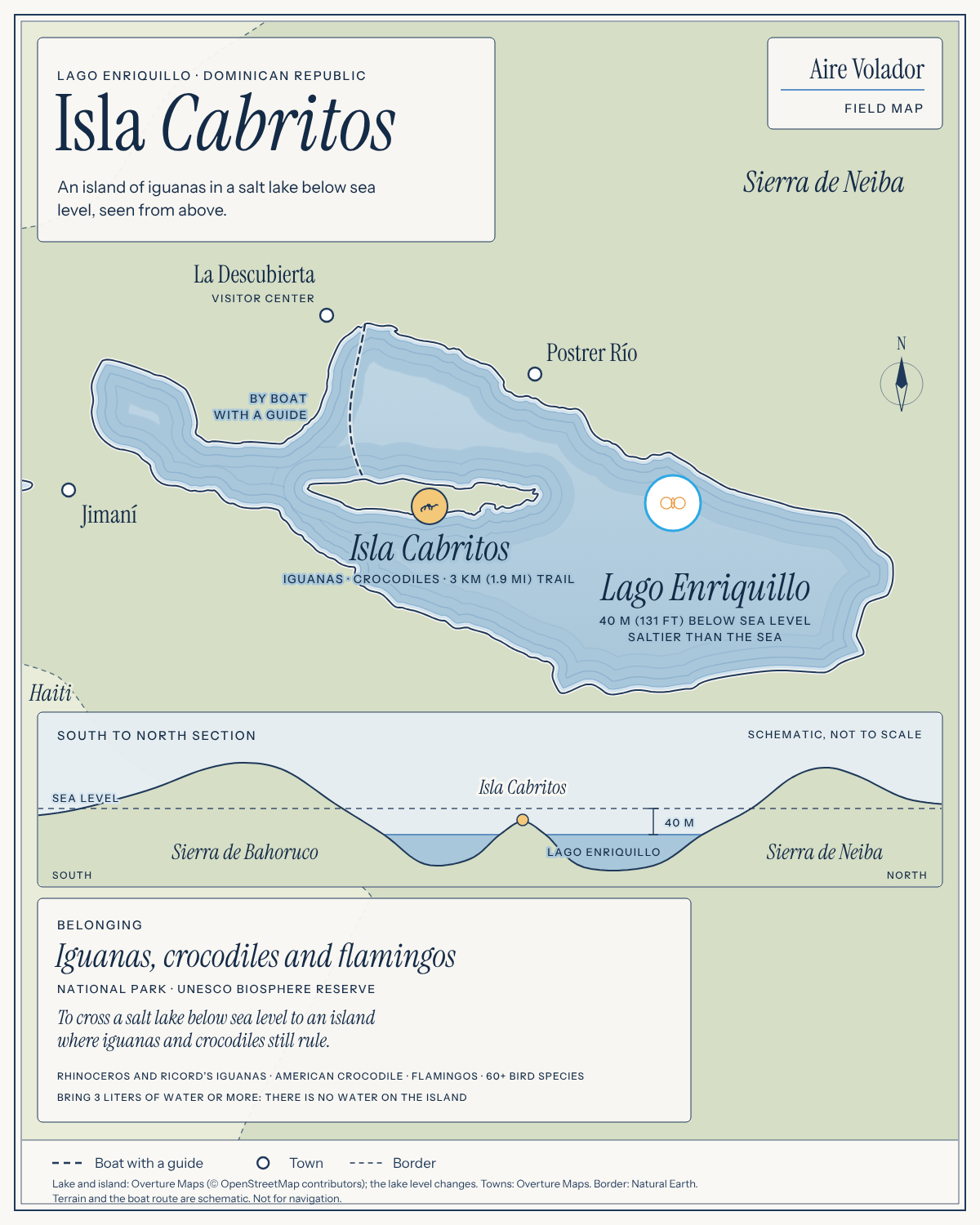
Isla Cabritos is a roughly 24-square-kilometer island sitting inside Lago Enriquillo, a hypersaline lake in the southwest Dominican Republic, within the provinces of Independencia and Bahoruco. [5] The lake itself is the largest in the Antilles and the lowest point in the entire island arc, lying approximately 40 meters below sea level. [1] The island and surrounding lake form the core of Parque Nacional Lago Enriquillo e Isla Cabritos, established as a national park in 1974 and covering 375 square kilometers. [1][5] The park is also a designated core zone of the Jaragua-Bahoruco-Enriquillo UNESCO Biosphere Reserve, approved in 2002. [1][5]
The lake occupies a rift valley formed by an ancient marine channel that once separated the two paleoislands that joined to become Hispaniola; trapped seawater gradually became the hypersaline lake visible today. [1][3] The island measures roughly 12 km long and 2.5 km wide at its broadest point, with dry sandy shores and a central plateau of fossilized coralline limestone. [3][5]
Activities & Experiences
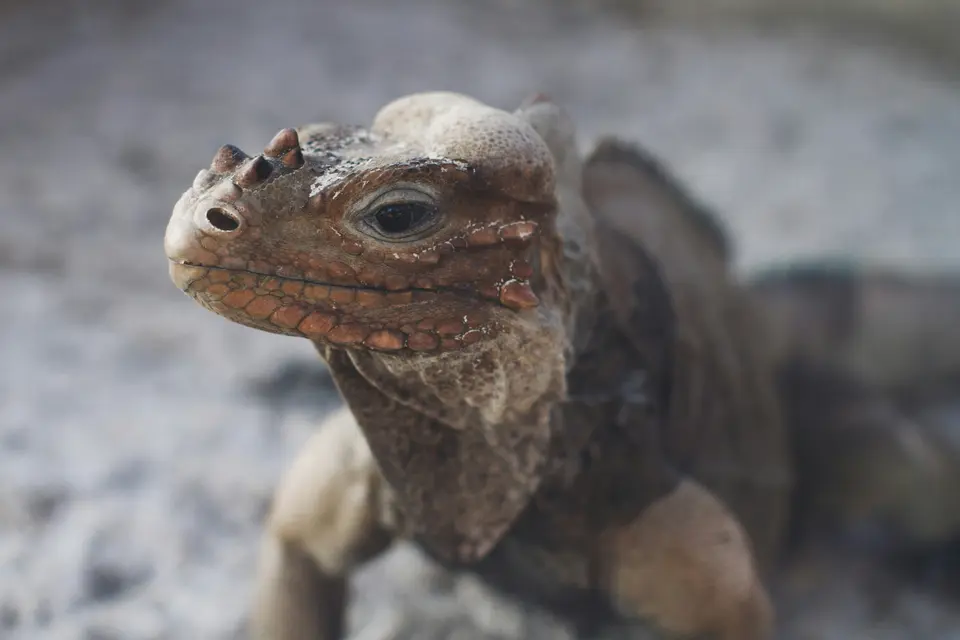
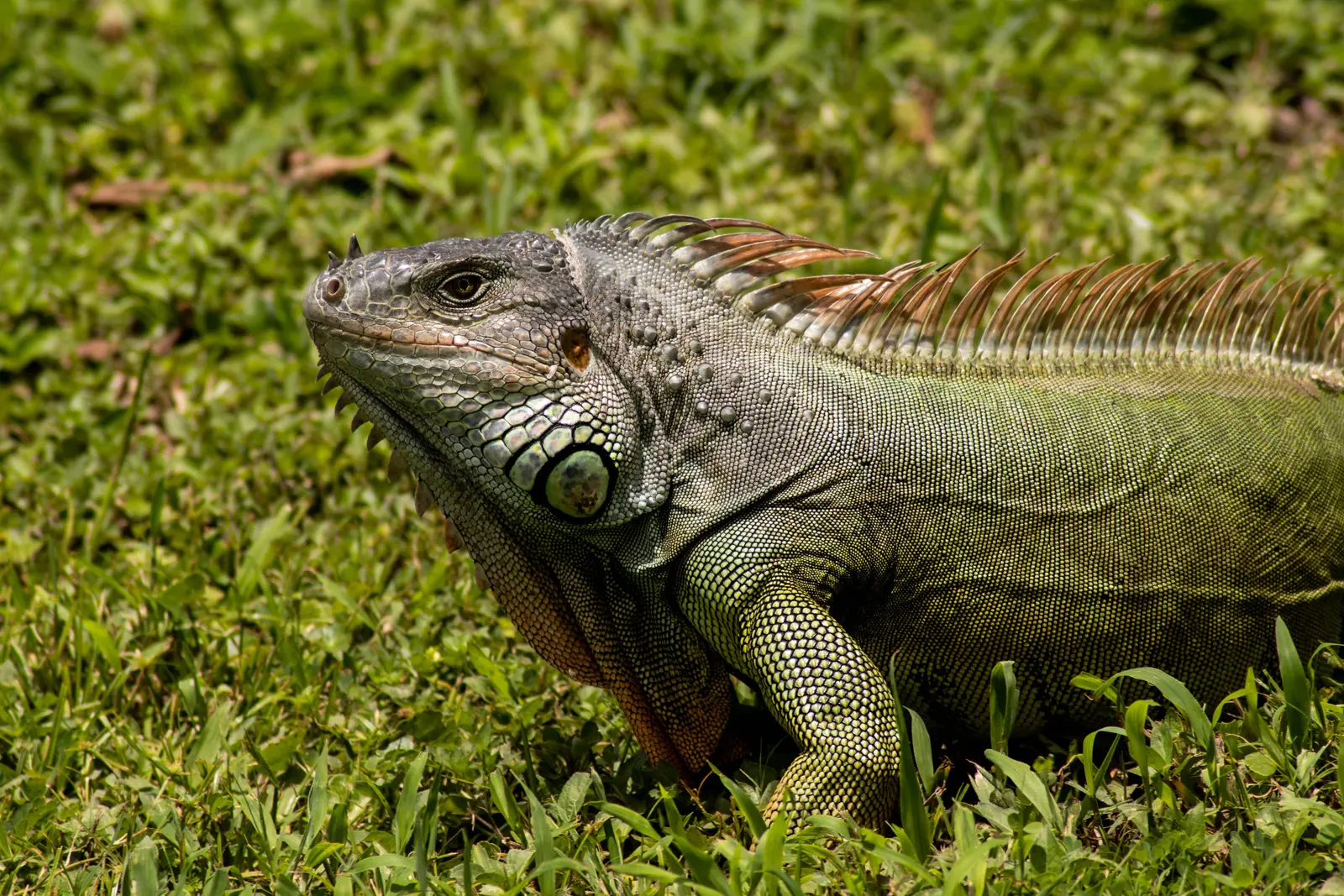
Visitors can observe wild American crocodiles, which bask on the island's shores and swim in the surrounding waters; Lago Enriquillo supports one of the largest wild populations of Crocodylus acutus in the world. [1][5] Two species of rock iguana share the island: the rhinoceros iguana (Cyclura cornuta), present in dense concentrations, and the critically endangered Ricord's iguana (Cyclura ricordii), making this one of the only places on Earth where both species coexist in the wild. [1][2][3] American flamingos feed in the shallow lake waters, and over 60 bird species have been recorded around the lake, including roseate spoonbills, various herons, and the Hispaniolan parakeet. [1]
A 3-kilometer loop trail crosses the island, and a lakeshore viewpoint trail is also available. [1] The boat ride to the island itself regularly yields crocodile sightings along the shore. [1] Wildlife viewing is most productive in the early morning, when crocodiles bask and iguanas are most active. [1]
Practical Access
The park entrance fee is RD$150, which covers access to Lago Enriquillo and Isla Cabritos; the boat to the island is hired separately. [1] Park hours are 8:00 AM to 4:00 PM, with boat departures available until 2:00 PM. [1] A guide is required for the visit. [1] A visitor center, boat dock, restrooms, and guide services are located at La Descubierta. [1]
The recommended visit duration is a half day to a full day. [1] The best time to visit is November through March, when temperatures are cooler, with early morning hours preferred for wildlife viewing. [1] Cell coverage is limited at La Descubierta and absent on the island and lake. [1] No food or water is available on Isla Cabritos, and visitors are advised to bring at least three liters of water per person. [1]
Restrictions
Camping is not permitted within the park. [1] No food or water is available on the island, making self-sufficiency mandatory. [1] Visitors must maintain a safe distance from wild crocodiles, which can move with explosive speed. [1] Lake water levels fluctuate significantly, which can affect access conditions. [1]
What Makes It Distinctive
Isla Cabritos is the only place on Earth where the critically endangered Ricord's iguana can live free of the invasive species that historically threatened it, following the successful removal of feral cats, donkeys, and cattle completed by 2017 through a collaboration between the Dominican Ministry of Environment, Island Conservation, and local partners. [2] Hispaniola is the only West Indian island where two Cyclura iguana species are sympatric, and Isla Cabritos is the primary site where this overlap can be observed. [3]
The combination of a hypersaline lake at the lowest point in the Antilles, one of the world's largest wild crocodile populations, and two critically threatened iguana species in a single compact island setting is found nowhere else in the Caribbean. [1][3][5] The park's designation as a core zone of a UNESCO Biosphere Reserve and its RAMSAR wetland status further underscore its global ecological significance. [1][5]
Sources
- Lago Enriquillo & Isla Cabritos | Crocodiles & Iguanas | Dominican Republic 365
- Isla Cabritos Declarada Libre de Mamiferos Invasores - Island Conservation
- Isla Cabritos: Beyond the Camera Lens - Island Conservation
Field map
- Open year-round
- Typical duration: 8h
Access & fees
- park entry fee
Things to do
- birdwatching: 60+ species
- boat excursion to island
- lakeshore viewpoint trail
- loop trail on island
- wildlife viewing: crocodiles
- wildlife viewing: flamingos
- wildlife viewing: rhinoceros iguana
- wildlife viewing: ricord's iguana
Before you go
- bring 3+ liters water per person
- cash needed for boat excursion
- extreme heat; bring ample water
- lake levels fluctuate; access may vary
- maintain distance from crocodiles
- very limited shade on island
Best time to visit
- november through march
Features
- hypersaline lake ecosystem
- invasive species removed by 2017
- island size 24 sq km
- lowest point in antilles
- national park since 1974
- only site: ricord's iguana invasive-free
- two cyclura species sympatric
- unesco biosphere reserve
Nearby
- las barias spring bathing spot
Good to know
- camping not allowed
- established 1974
- guide required
- no cell coverage on island
- no food or water on island
- park area 375 km2
- visit duration half to full day
- visitor center at la descubierta
Photos