Hoh Rainforest
About
What It Is
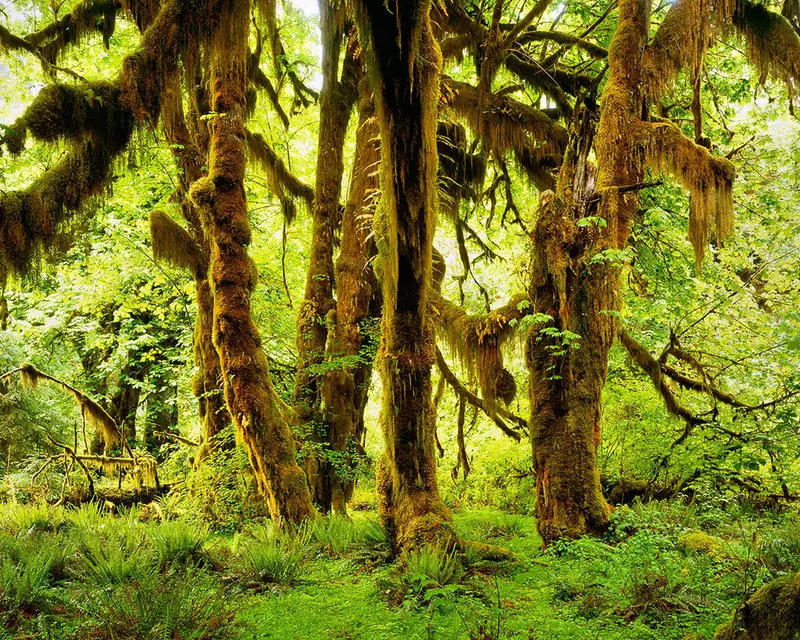
The Hoh Rain Forest is a temperate rainforest located on the western slope of the Olympic Mountains within Olympic National Park, on the Olympic Peninsula in western Washington state. It covers approximately 24 square miles of low-elevation forest along the Hoh River valley, ranging from roughly 394 to 2,493 feet in elevation [5]. The forest is one of the largest and most accessible temperate rainforests remaining in the contiguous United States, and in 2024 approximately 460,000 people visited the Hoh District [5]. Within the park boundary, the forest is protected from commercial exploitation [5].
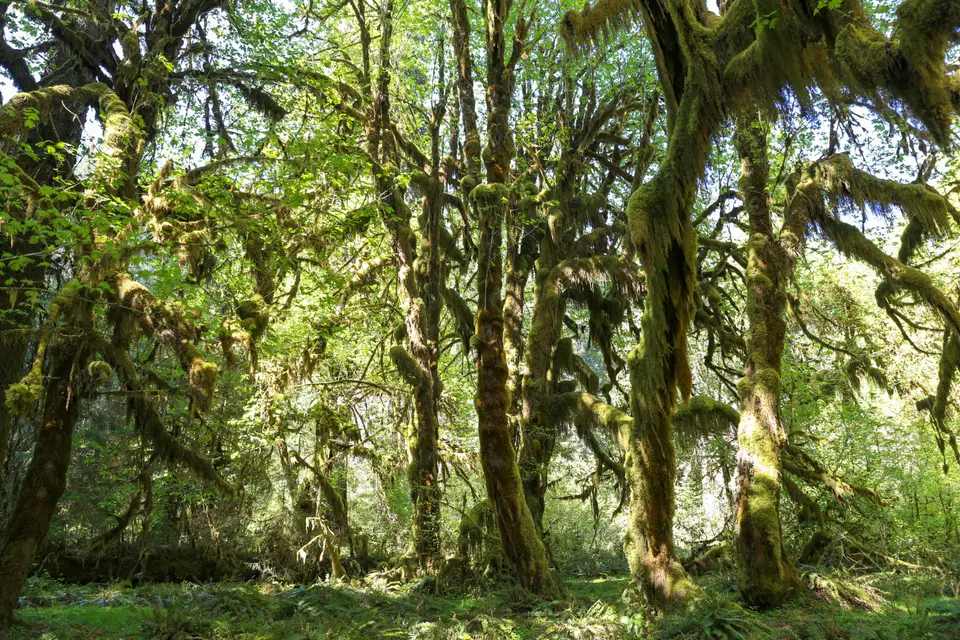
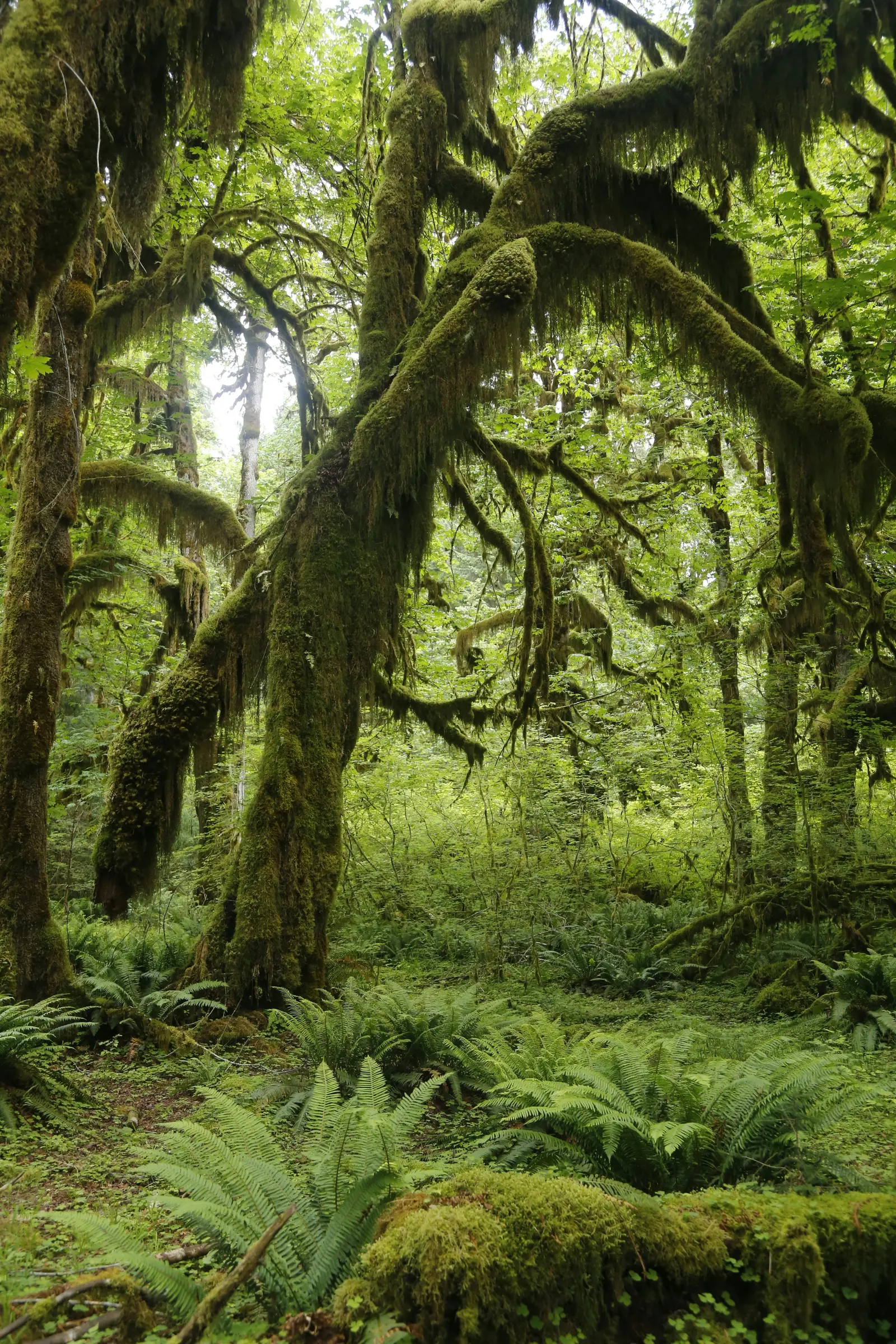
The rainforest receives an average of 140 inches of precipitation per year, with the bulk falling between October and March as Pacific storms stall against the Olympic range [1][4]. This sustained moisture supports a dense canopy of Sitka spruce, western hemlock, western red cedar, and bigleaf maple, with mosses and ferns blanketing nearly every surface [5]. Some individual trees exceed 300 feet in height [5].
Activities & Experiences
Three maintained trails depart from the Hoh Rain Forest Visitor Center. The Hall of Mosses Trail is a 0.8-mile loop through old-growth forest, passing a grove of bigleaf maple draped in club moss [1][4]. The Spruce Nature Trail is a 1.2-mile loop that moves through old and new growth forest alongside Taft Creek and the Hoh River, with interpretive signs identifying trees and plants along the way [1][5]. Both short trails can be completed in under an hour.
The Hoh River Trail is the area's primary long-distance route, extending 18.5 miles one-way to the Blue Glacier moraine at the foot of Mount Olympus, with a total elevation gain of roughly 3,700 feet before reaching Glacier Meadows at mile 17.3 [1][4]. Day hikers commonly walk the first 2 to 6 miles and turn back; popular turnaround points include First River Access at 0.9 miles, Mineral Creek Falls at 2.7 miles, Cedar Grove at 4.0 miles, and 5-Mile Island at 5.0 miles [1]. The Hoh Lake Trail branches off the Hoh River Trail near the ranger station and climbs toward Bogachiel Peak [1]. The Hoh Valley also supports the largest Roosevelt elk herd in Olympic National Park, with roughly 300 animals present year-round and frequently visible along the river corridor and forest edge [4].
Practical Access
The Hoh Rain Forest is reached via Upper Hoh Road, an 18-mile paved two-lane road that turns east off Highway 101 approximately 13 miles south of Forks [1][4]. The drive from Port Angeles takes roughly 1 hour 45 minutes; from Forks, approximately 40 minutes [4]. No cell service is available on Upper Hoh Road or at the visitor center, so offline maps should be downloaded before leaving the highway [4]. RVs longer than 21 feet may have difficulty in the main parking lot, which holds approximately 80 cars and fills by 9 a.m. on summer weekends; overflow parking is available about 0.3 miles back on the road [4].
Olympic National Park charges a vehicle entrance fee of USD 35, valid for 7 days; the America the Beautiful Annual Pass at USD 80 covers entry [4]. The Hoh Rain Forest Visitor Center is open daily in summer, closed January through early March, and generally open Friday through Sunday in spring and fall, with hours varying by season [1]. The campground has 72 sites in old-growth forest along the river and is open year-round; during the 2026 peak reservation season (June 12 to September 6), sites are reservable at recreation.gov in staggered block releases up to 6 months in advance, with first-come, first-served availability outside that window [1][3]. A 7-day maximum stay limit applies during the reservation season [3].
Restrictions
Pets are not permitted on any trails in the Hoh Rain Forest; they are allowed on leash in developed areas such as the campground, picnic areas, and parking lots [1][3]. All backcountry overnight permits must be reserved online through the Olympic National Park Wilderness Permit page at recreation.gov [3]. The RV dump station at the campground is closed indefinitely; the nearest dump facilities are at Bogachiel State Park, 23 miles north, or Kalaloch Campground, 33 miles south, both requiring payment [3]. There are no RV hookups at the campground [3].
What Makes It Distinctive
The Hoh is the largest and most accessible temperate rainforest in the contiguous United States, offering an ecosystem type found nowhere else in the lower 48 states at this scale [1][4][5]. Its annual precipitation of 140 inches or more produces biomass densities and tree sizes — some Sitka spruce exceeding 300 feet tall — that rival tropical systems despite the cool, oceanic climate [4][5]. The forest also contains the One Square Inch of Silence, a monument placed in 2005 to mark what has been described as the quietest place in the United States [5].
The combination of short, accessible loop trails and a long wilderness route to the foot of Mount Olympus means the Hoh serves both casual visitors and serious backcountry travelers within the same trailhead area [1][4]. The resident Roosevelt elk herd, the largest in the park, adds consistent wildlife-viewing opportunities that are unusual for a heavily visited rainforest destination [4].
Sources
- Visiting the Hoh Rain Forest - Olympic National Park (U.S. National Park Service)
- Alerts & Conditions - Olympic National Park (U.S. National Park Service)
- Hoh Rainforest Campground, Olympic National Park - Recreation.gov
- Hoh Rainforest Washington: A Complete Visitor Guide | GoVisit Washington
- Hoh Rainforest
- Open year-round
- Best months: May–October
- Typical duration: 3h
Access & fees
- $35 per vehicle
- america the beautiful annual pass
Things to do
- backcountry camping
- hall of mosses loop hike
- hoh lake trail hike
- hoh river trail hike
- spruce nature trail hike
- wildlife viewing — roosevelt elk
Before you go
- summer parking fills early
Amenities
- campground — 72 sites
- firewood sales, b-loop
- food storage lockers at campground
- hoh rain forest visitor center
Best time to visit
- arrive by 6am weekends in summer
- elk viewing — early morning
- weekday morning visit
Features
- annual precipitation
- elevation range
- hoh river valley, olympic mountains west slope
- largest accessible temperate rainforest, contiguous us
- one square inch of silence
- roosevelt elk herd
- temperate old-growth rainforest
- trees up to 200 ft tall, 1,000 yrs old
Nearby
- bogachiel state park — 23 mi
- forks, wa — ~31 mi west
- kalaloch campground — 33 mi south
- port angeles — ~89 mi east
Good to know
- 7-day max stay, reservation season
- campground reservations required peak season
- drive from forks
- main parking lot ~80 cars
- no cell service on upper hoh road
- no rv hookups or dump station
- pets prohibited on all trails
- rvs over 21 ft not recommended
Photos