Freedom Plaza
About
What It Is
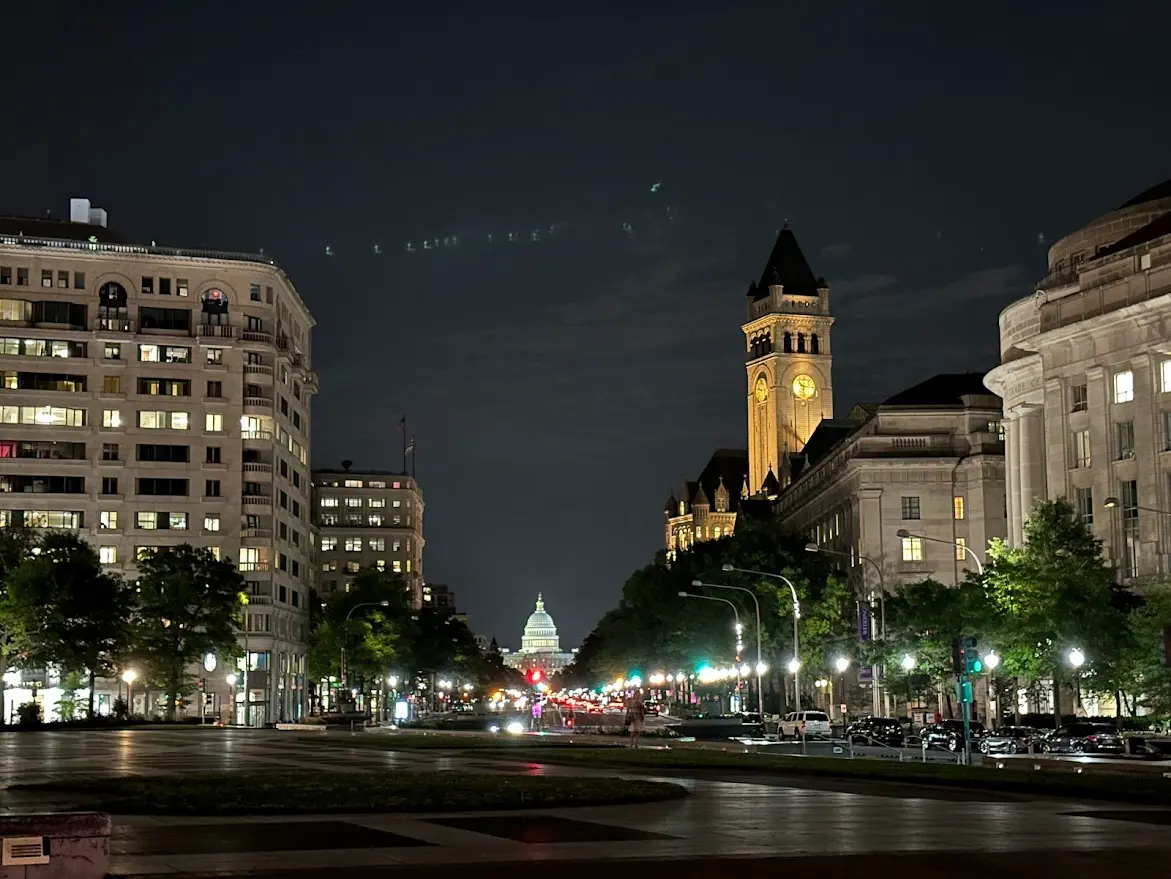
Freedom Plaza is an open public plaza in Northwest Washington, D.C., situated near the intersection of 14th Street and Pennsylvania Avenue NW, adjacent to Pershing Park [1]. Administered by the National Park Service as part of the Pennsylvania Avenue National Historic Site, it was originally built by the Pennsylvania Avenue Development Corporation and dedicated in 1980 under the name Western Plaza [1]. It was renamed in 1988 to honor Martin Luther King Jr., who drafted portions of his "I Have a Dream" speech at the nearby Willard Hotel [1]. The plaza is surrounded by significant civic and cultural landmarks, including the John A. Wilson Building, the National Theatre, and the Old Post Office building [1].
Activities & Experiences
Visitors can walk across the raised stone surface and examine its most distinctive feature: a large inlay depicting Pierre Charles L'Enfant's original plan for Washington, D.C., rendered in dark and light marble [1]. Brass outlines mark the locations of the White House and the Capitol within the plan, and quotes about the city from historical visitors and residents are carved directly into the marble [1]. The plaza also contains a granite-walled fountain in its western section, flagpoles flying D.C. and U.S. flags, and a metallic plaque bearing the Great Seal of the United States with an accompanying inscription [1]. An equestrian statue of Kazimierz Pulaski, installed in 1910, stands at the eastern end, and as of May 2026, thirteen bronze statues depicting American leaders of the Revolutionary War have been installed around the plaza, including a central equestrian statue of Caesar Rodney [1].
Practical Access
Freedom Plaza is an open public space on Pennsylvania Avenue NW and is freely accessible at all times [1]. No entry fee is charged [1]. The plaza is one block from the Freedom Plaza stop on the Civil War to Civil Rights Downtown Heritage Trail, marked at 13th and E Streets NW [1]. Most of the plaza surface is raised above street level, which visitors should note when planning access [1].
Restrictions
Skateboarding is prohibited at the plaza, though the National Park Service notes it is a persistent enforcement challenge; signs prohibiting the activity have been removed by vandals, and the practice causes ongoing damage to stonework, walls, steps, and sculpture [1].
What Makes It Distinctive
Freedom Plaza is one of very few public spaces in the United States where visitors can stand on a to-scale map of a city's founding plan, with the White House and Capitol marked directly underfoot in brass [1]. Its location on Pennsylvania Avenue, between the seat of D.C. government and the historic National Theatre, places it at the center of the capital's civic life, and it has served as a gathering point for major political demonstrations across decades [1]. A time capsule containing items connected to Martin Luther King Jr. was buried on site in 1988 and is not scheduled to be opened until 2088, giving the plaza an unusual long-horizon historical dimension [1].
Sources
- Open year-round
- Typical duration: 0.5h
Access & fees
- free entry
Things to do
- civic walking and sightseeing
- political demonstrations
Events & seasons
- political protests and rallies
- public protests and events
Features
- bronze statues (13)
- carved marble quotations
- granite fountain
- great seal plaque
- l'enfant plan inlay
- pulaski equestrian statue
- time capsule (buried 1988)
Nearby
- civil war to civil rights trail
- john a. wilson building
- national theatre
- pershing park
- waldorf astoria washington d.c.
Good to know
- nps administered
- open public plaza
- raised above street level