Diamond Head
About
What It Is
Diamond Head, known in Hawaiian as Lēʻahi, is a volcanic tuff cone on the island of Oʻahu, Hawaii, situated near the eastern edge of Waikiki's coastline [1][3]. The Hawaiian name most likely derives from the words for promontory and tuna, referencing the ridgeline's resemblance to a tuna's dorsal fin, while British sailors in the 19th century named it after calcite crystals on the adjacent beach that they mistook for diamonds [3]. The crater and its surrounding slopes, covering more than 475 acres, are protected as a State Monument and have been designated a U.S. National Natural Landmark since 1968 [1][3]. The crater was formed roughly 300,000 to 500,000 years ago during a single explosive eruption and is part of the broader Honolulu Volcanic Series [1][3].
Activities & Experiences
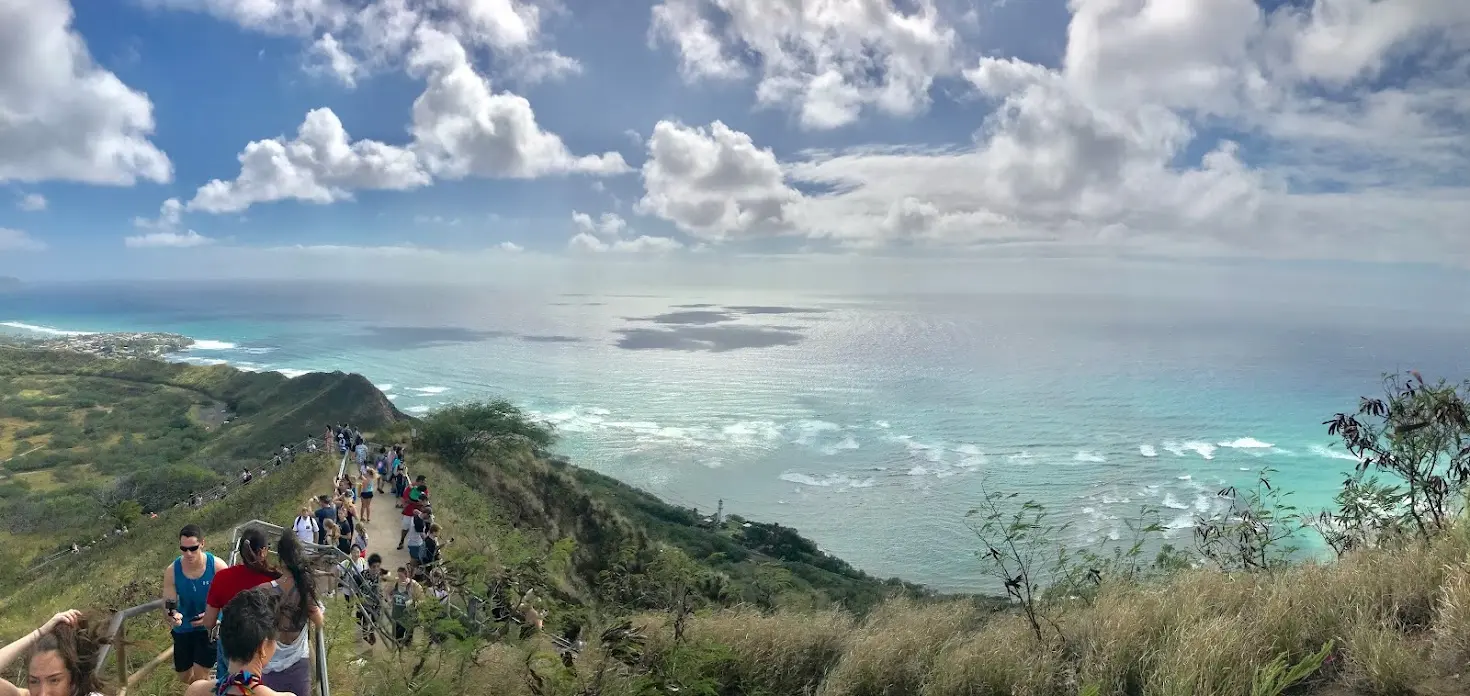
The primary visitor activity is the Diamond Head Summit Trail, a 0.8-mile route from the crater floor to the summit that gains 560 feet in elevation [1][3]. The trail passes through a lighted 225-foot tunnel and up steep stairs to reach the Fire Control Station completed in 1911, where bunkers used to direct coastal artillery fire are still visible [1]. From the summit, visitors take in panoramic views stretching from Koko Head to the Waianae coast, and during winter months humpback whales may be visible offshore [1]. An interpretive kiosk on the crater floor houses exhibits on the site's history and natural resources, and a self-guided audio tour covering history, culture, geology, and wildlife is available [1].
Practical Access
The monument is open daily from 6:00 am to 6:00 pm, with the last reservation slot at 4:00 pm and the last entry for that slot at 4:30 pm; the gates close at 6:00 pm and all visitors must exit by then [1]. The site is closed on Christmas and New Year's Day [1]. Entry is free for Hawaii residents with a valid Hawaii ID or driver's license; non-residents pay USD 5 per person, and children aged 3 and under enter free [1]. Non-resident vehicle parking costs USD 10 per non-commercial vehicle, and reservations for both entry and parking are required for non-residents (as of May 12, 2022) [1]. The crater floor facilities are fully accessible to visitors with disabilities, but the summit trail is not ADA accessible due to steep and uneven terrain, including an especially steep staircase covering the final one-tenth of a mile [1]. Plan for 1.5 to 2 hours to complete the hike; sturdy footwear, water, a hat, and sunscreen are recommended [1].
Restrictions
Pets are not permitted anywhere in the park, with the exception of service animals [1]. Non-residents must hold advance reservations for both entry and parking (as of May 12, 2022); walk-up access without a reservation is not available to non-residents [1]. Payment at the entrance is by credit card only [1]. A portion of the crater is closed to the public and operates as a platform for U.S. government antennas [3].
What Makes It Distinctive
Diamond Head is Hawaii's most recognized landmark and one of the most heavily visited destinations in the state, drawing more than 3,000 visitors per day [1]. It combines geological significance, intact early-20th-century military infrastructure, and sweeping coastal views in a single compact hike accessible from central Waikiki [1][3]. Its dual status as both a State Monument and a U.S. National Natural Landmark, along with its deep presence in Hawaiian cultural identity and global popular culture, sets it apart from other volcanic features on Oahu [3].
Sources
- Diamond Head State Monument – Division of State Parks
- Department of Land and Natural Resources – Making Hawai`i a Great Place to Live!
- Diamond Head, Hawaii
- Open year-round
- Best months: January–April
- Typical duration: 2h
Access & fees
- children 3 and under entry
- commercial vehicle fees
- hawaii resident entry
- non-resident entry $5
- non-resident parking $10
- resident vehicle parking
- small fee required
Things to do
- birdwatching
- explore volcanic geology
- exploring historic military structures
- interpretive exhibits
- panoramic coastal views
- photography
- picnicking on the crater floor
- scenic viewing from the summit
- summit hiking trail
- walking through the historic tunnel
- whale watching
Before you go
- gates locked at 6:00 pm
- reservations required for non-residents
Amenities
- ada-accessible crater floor
- interpretive kiosk & gift shop
- self-guided audio tour
Best time to visit
- whale watching season
- winter for whale sightings
Events & seasons
- diamond head crater festivals
- seasonal whale spotting from the summit
Features
- 1911 fire control station
- 1917 navigational lighthouse
- 225-foot lighted tunnel
- 475-acre crater
- hawaiʻi state monument
- military bunkers at summit
- military tunnel and bunkers
- national natural landmark
- pacific ocean/coastal viewing
- panoramic south-shore views
- panoramic views of waikīkī and honolulu
- stairs and tunnels
- u.s. national natural landmark
- volcanic tuff cone
- volcanic tuff crater
Nearby
- diamond head lighthouse
- koko head to wai'anae
- waikīkī coastline
- waikīkī resort hotels
Good to know
- accessibility
- annual closures
- daily operating hours
- hawaiʻi state parks rates it moderate, although the combination of heat, stairs and steep sections can make it feel more strenuous.
- no pets allowed
- online reservation required
- open 6 am–6 pm daily
- payment method
- reservations required
- this is primarily a hiking + scenic-view + historical attraction, rather than a general recreation park.
- trail difficulty
- typical visit duration