Cadaqués
About
What It Is
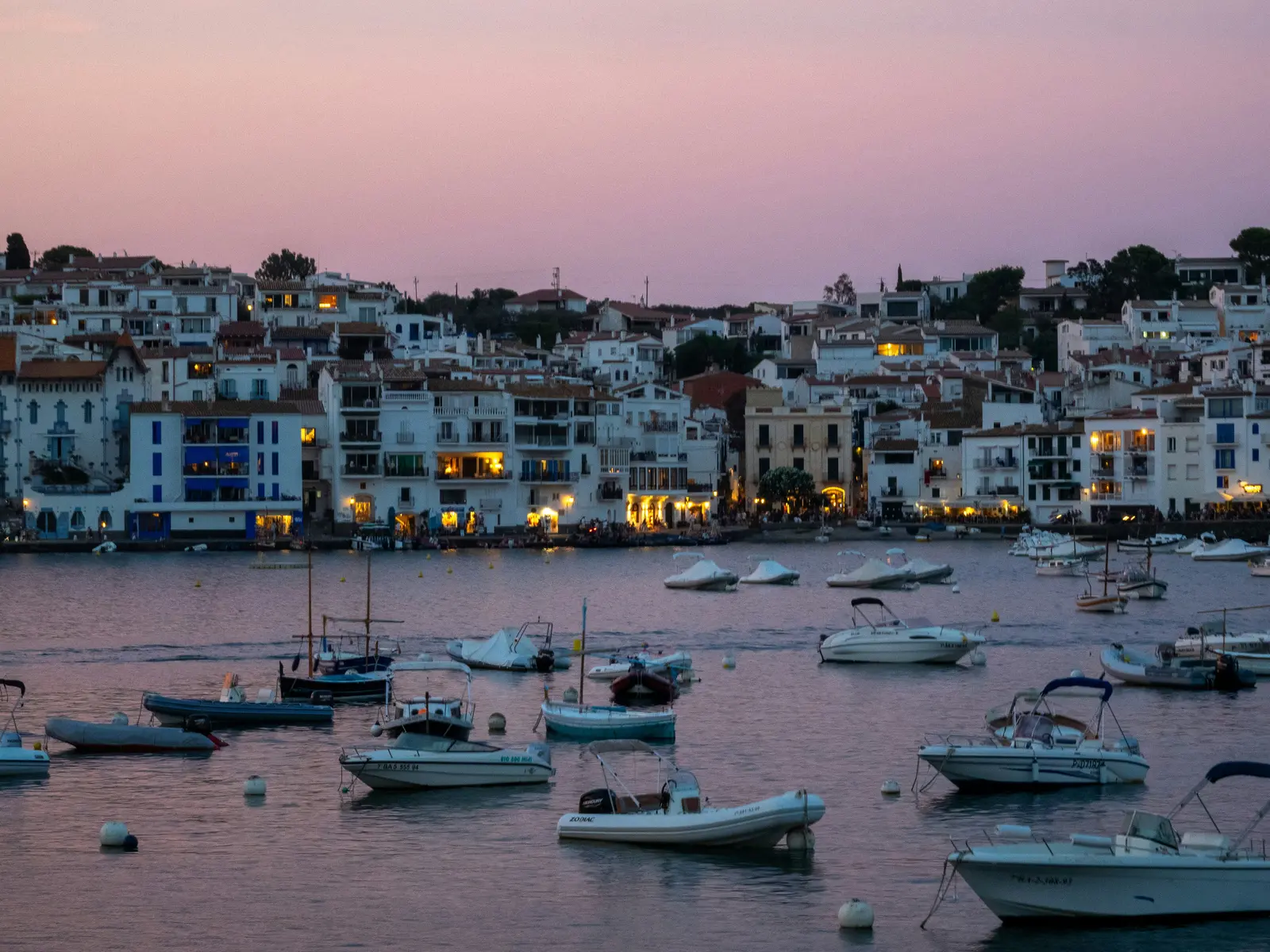
Cadaqués is a whitewashed fishing town on the northern Costa Brava, situated in a wide bay on the Cap de Creus peninsula in the Alt Empordà comarca, province of Girona, Catalonia, Spain [2][3]. It sits near Cap de Creus, the easternmost point of the Iberian peninsula, roughly 6 km from the town centre [3]. The town has an official resident population of around 2,752, though during peak summer months that figure can swell to ten times as many [2]. Its compact historic centre of narrow cobbled streets and low houses clusters around the church of Santa Maria [3].
Cadaqués holds a notable place in art history, having attracted Salvador Dalí, Pablo Picasso, Joan Miró, Marcel Duchamp, and many other significant artists over the decades [2]. Dalí maintained a home in Port Lligat, a small village on a bay immediately adjacent to the town, and a summer visit in 1916 is considered particularly formative to his artistic development [2].
Activities & Experiences
Visitors can explore a range of beaches along the town's coastline, varying in size and composition from small rocky coves to gravel and coarse-sand stretches [3]. Platja des Sortell features a stone bridge, the Pont des Sortell, connecting to a small island where a viewpoint at 10.5 metres above sea level offers panoramic views of the bay [3]. Platja de sa Conca, oriented east-southeast, has a signposted coastal path of approximately 3.5 kilometres leading toward the Calanans lighthouse [3].
Dalí's former home in Port Lligat, about 15 to 20 minutes on foot from the town centre, now operates as a museum [3]. The ruins of Sant Jaume Castle, a 17th-century fortress with a history spanning observation, signalling, and later defensive use, can also be visited [3]. On Mondays a travelling market takes place near the parking area, offering a wide variety of products [2]. The old Jewish quarter from the medieval period remains accessible to visitors [2].
Practical Access
Cadaqués is approximately two hours and fifteen minutes by road from Barcelona [2]. By public transport, travellers can take a train from Barcelona to Figueres and then connect by bus; the company Sarfa also operates a direct daily bus service from Barcelona's North Station [3]. Ferry connections from the nearby town of Roses run several times a day during much of the year [3]. Driving is straightforward via the C-68 toward Roses and then following signs to Cadaqués; free parking areas exist in the town, including one near the beach open from 09:00 to 20:00 [3].
Within the town, most points of interest are reachable on foot [3]. A marked coastal trail of approximately 15 km connects Roses to Cadaqués, following the coastline and marked with red and white painted signs on rocks and posts [3]. Visitors wishing to tour Dalí's house in Port Lligat must book a time slot in advance, as entry is limited to approximately 10 people every 10 minutes [3].
Restrictions
Nudism is practised at Platja de sa Conca [3]. Dogs are permitted on Platja de Pius V and Platja des Sortell [3]. Bus timetables are significantly reduced on public holidays, which can result in waits of several hours between services [3].
What Makes It Distinctive
Cadaqués is one of the few towns in Spain where the physical isolation imposed by surrounding coastal hills has preserved both a medieval street layout and a distinct local variant of the Catalan language dating to the Middle Ages [2][3]. Its sustained association with an exceptional concentration of 20th-century artists, from Dalí and Picasso to Duchamp and Miró, gives it an art-historical depth unusual for a small fishing town of its size [2]. The proximity of Cap de Creus Natural Park and the easternmost point of the Iberian peninsula adds a landscape dimension that extends well beyond the town's beaches and historic centre [3].
Sources
- Best months: May–October
- Typical duration: 8h
- Hours: 24/7
Things to do
- art galleries and local boutiques
- boat excursions along the costa brava
- explore cap de creus natural park
- hiking coastal trails
- kayaking and paddleboarding
- photography
- relax at nearby beaches and coves
- seafood dining
- stroll along the waterfront promenade
- swim and snorkel in the mediterranean
- vespa rental
- visit castell de sant jaume
- visit dalí house museum
- visit salvador dalí house-museum
- wander the whitewashed old town
Best time to visit
- summer peak season
- visit in may, june, september, or october for pleasant weather and fewer crowds.
Events & seasons
- monday market
Features
- cap de creus natural park
- dalí artistic connection
- medieval jewish quarter
Nearby
- figueres (train hub)
- the village is crowned by the church of santa maria, whose hilltop location offers panoramic views of the bay.
Good to know
- bus: barcelona–cadaqués
- dalí house advance booking
- drive from barcelona
- no direct train
- reserve tickets well in advance for the dalí house-museum, as daily capacity is limited.