Brooklyn Bridge
About
What It Is
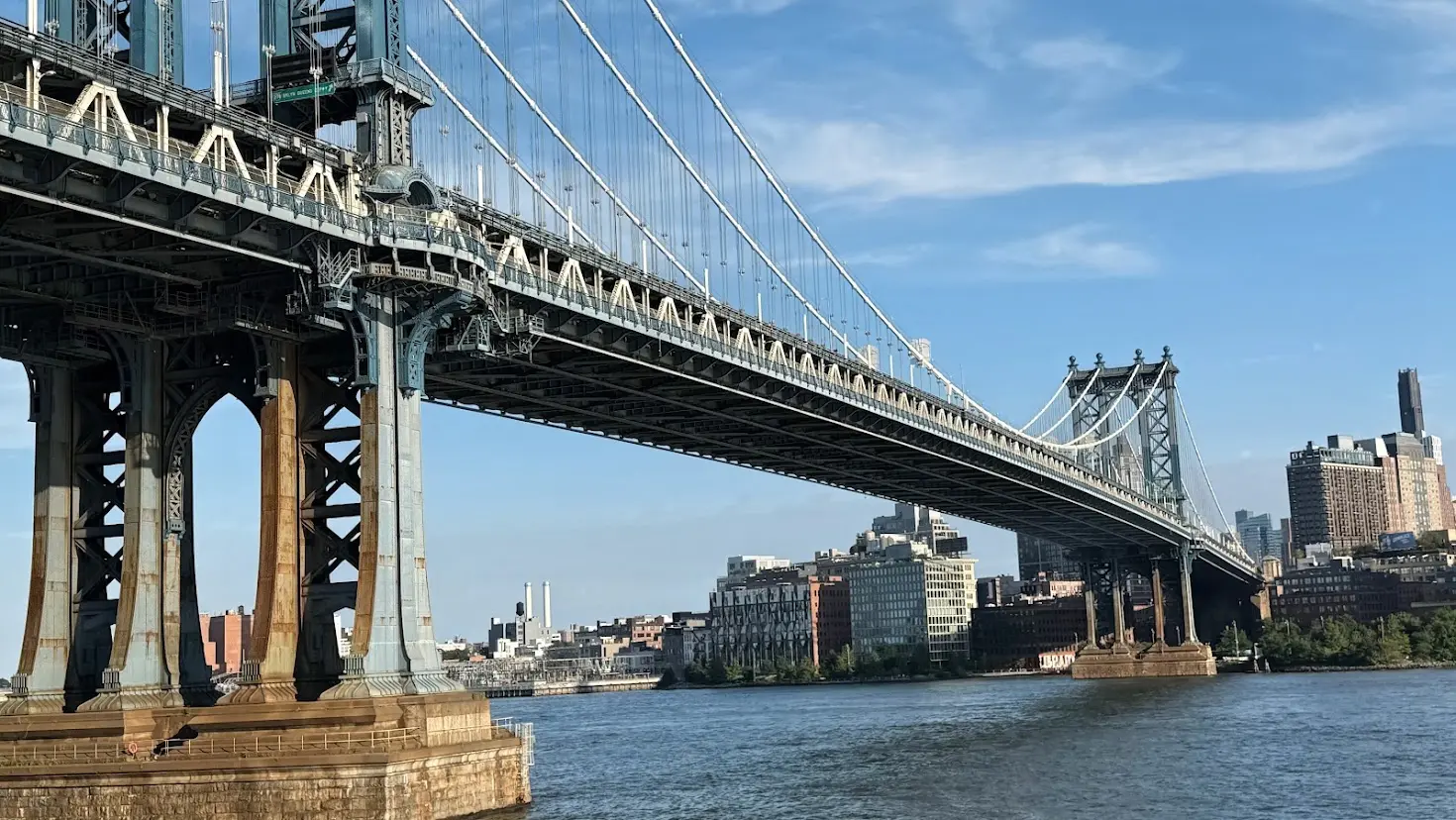
The Brooklyn Bridge is a steel-wire suspension bridge crossing the East River between Manhattan and Brooklyn in New York City [1]. It opened on May 24, 1883, making it the first fixed crossing of the East River and, at the time, the longest suspension bridge in the world, with a main span of 1,595.5 feet (486.3 m) and a deck clearance of 127 feet above mean high water [1]. The bridge was designed by John A. Roebling, with construction led by his son Washington Roebling and engineering contributions from Washington's wife, Emily Warren Roebling; the project took thirteen years to complete [1]. It is designated a National Historic Landmark, a New York City landmark, and a National Historic Civil Engineering Landmark [1].
The bridge uses a hybrid design combining cable-stayed and suspension elements, with both vertical and diagonal suspender cables, and features neo-Gothic stone towers with pointed arches [1]. Its total length, including approach viaducts on both shores, is 6,016 feet (1,834 m) [1].
Activities & Experiences
Visitors can walk or cycle across the bridge on an elevated pedestrian-only promenade that runs between the two roadways and sits 18 feet above them [1]. The promenade is generally 10 to 17 feet wide and rises near each tower to connect to a balcony that slightly overhangs the roadways, offering elevated views of the East River and the surrounding city [1]. The bridge has served as a site for stunts and performances throughout its history and remains a major tourist attraction [1].
Practical Access
Only passenger vehicles and pedestrian and bicycle traffic are permitted on the bridge [1]. Pedestrians and cyclists access the promenade from either the Manhattan or Brooklyn side; the approach ramp from Manhattan is 1,567 feet long, while the Brooklyn approach ramp is 971 feet long [1]. The bridge is maintained by the New York City Department of Transportation [1].
Restrictions
Only passenger vehicles, pedestrians, and cyclists are allowed on the bridge; no other vehicle types are permitted [1]. The elevated promenade is reserved exclusively for pedestrian and bicycle use, separated from the vehicle roadways [1].
What Makes It Distinctive
The Brooklyn Bridge was the first fixed crossing of the East River and held the record as the world's longest suspension bridge when it opened in 1883, representing a landmark achievement in engineering at the time [1]. Its hybrid cable-stayed and suspension design, combined with neo-Gothic stone towers, gives it an architectural character that distinguishes it from later utilitarian bridges [1]. As the southernmost of five vehicular bridges linking Manhattan and Long Island, and one of the most recognized structures in New York City, it carries both practical transit function and deep cultural significance [1].
Sources
- Open year-round
- Typical duration: 2h
Access & fees
- free
Things to do
- birdwatching along the waterfront
- cycling across bridge
- join guided walking tours
- learn about the bridge's engineering and history
- pedestrian bridge walk
Best time to visit
- early morning
Features
- elevated pedestrian promenade
- main span 1,595.5 ft
- national historic landmark
- neo-gothic stone towers
- tower balcony overlooks
Nearby
- manhattan bridge
- visit nearby dumbo and brooklyn bridge park
- williamsburg bridge
Good to know
- brooklyn entry near sands street
- cycle across the bridge (designated bike lane)
- manhattan entry near park row
- no commercial vehicles
- photography
- view the statue of liberty, east river, and lower manhattan
- walk across the pedestrian promenade
- watch sunrise or sunset over the manhattan skyline